A professional walkie-talkie is more than a handheld communication device. It is a combination of RF electronics, audio processing, control circuitry, an antenna system and a power supply, all working together to provide reliable two-way communication.
For industrial facilities, security operations and infrastructure projects, selecting a radio requires more than checking its advertised range or transmit power. The radio must meet the communication requirements of the application, operate reliably in its intended environment and remain compatible with the wider radio system.
Understanding the main components and their functions makes it easier to evaluate radio specifications, compare equipment and identify the right solution for a particular application.
1. The Main Components of a Professional Walkie-Talkie
A typical professional handheld radio contains several functional sections. Their exact arrangement depends on the radio architecture, supported frequency bands and whether the device uses analog, digital or dual-mode communication.
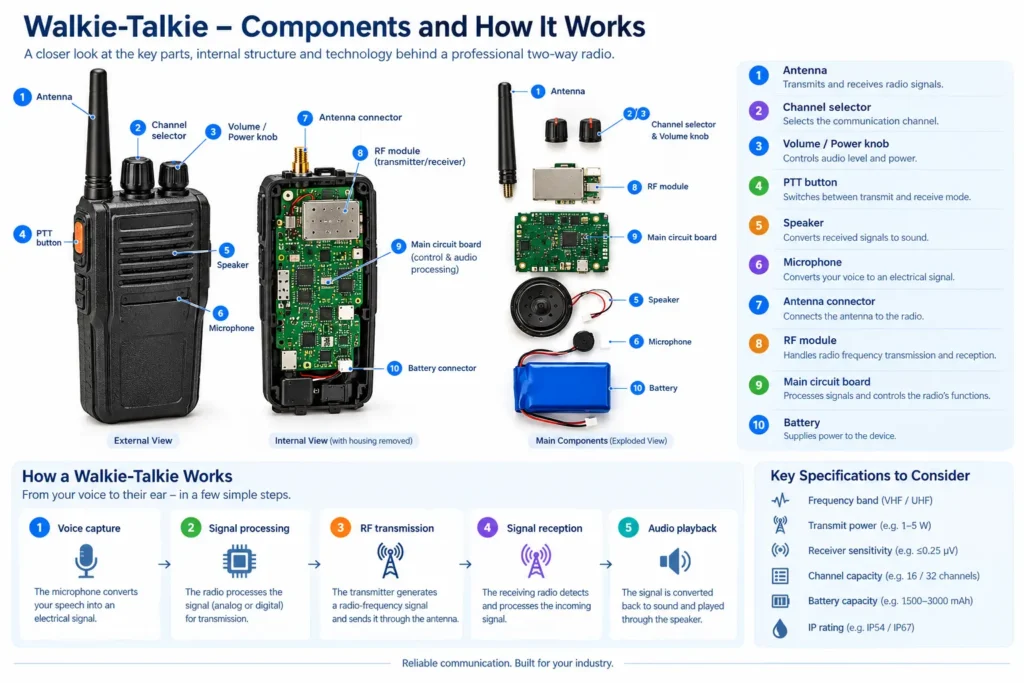
Antenna
The antenna provides the interface between the radio’s electronic circuitry and the electromagnetic waves travelling through the air.
During transmission, the RF output is delivered to the antenna, which radiates electromagnetic energy. During reception, the antenna captures incoming signals and transfers them to the receiver.
Antenna performance depends on factors such as frequency, electrical design, matching, efficiency and installation. In practical use, antenna placement, the user’s body, nearby structures and surrounding terrain also influence coverage.
RF transmitter and receiver
The RF section is responsible for sending and receiving radio signals.
The transmitter generates the required radio-frequency signal and applies the modulation or digital transmission method supported by the device. The receiver processes incoming signals to recover the transmitted voice or data.
Receiver performance is not determined by sensitivity alone. Selectivity, adjacent-channel rejection, blocking performance and resistance to unwanted signals can also matter in environments where multiple radio systems operate nearby.
Main control board
The main printed circuit board connects and coordinates the radio’s electronic functions.
Depending on the design, it may contain a microcontroller, RF integrated circuits, memory, power-management circuitry and audio-processing components. In a digital radio, the electronics also support the relevant voice encoding, decoding and digital communication functions.
The overall circuit design and integration affect power consumption, functionality, reliability and the radio’s ability to meet its specified performance requirements.
Microphone and audio circuitry
The microphone converts the user’s voice into an electrical signal. Audio circuitry processes this signal before it reaches the transmitter.
On reception, the radio recovers the incoming voice signal and processes it for playback through the speaker.
For security teams, factory personnel and other users working in noisy environments, intelligible voice communication is particularly important. Microphone characteristics, speaker output, audio processing and the acoustic design of the housing all contribute to the user experience.
Battery and power-management circuit
The battery supplies the energy required by the transmitter, receiver, control electronics and audio system.
Battery capacity, commonly expressed in mAh, provides useful information for comparing batteries, but it does not establish operating time by itself. Runtime also depends on battery voltage, transmit duty cycle, receive and standby consumption, environmental conditions and battery ageing.
For radios intended for long shifts, battery endurance should be evaluated against the actual operating pattern rather than relying exclusively on a capacity figure.
Housing, controls and connectors
The external housing protects the electronics and provides access to the controls, connectors and user interface.
Important design considerations include mechanical durability, grip, button placement, connector protection and ease of operation while wearing gloves. The required environmental protection should be assessed against the radio’s documented IP rating and intended operating conditions.
[Insert a labelled photograph or exploded-view illustration of an actual radio model here.]
2. What Happens When a User Presses the PTT Button?
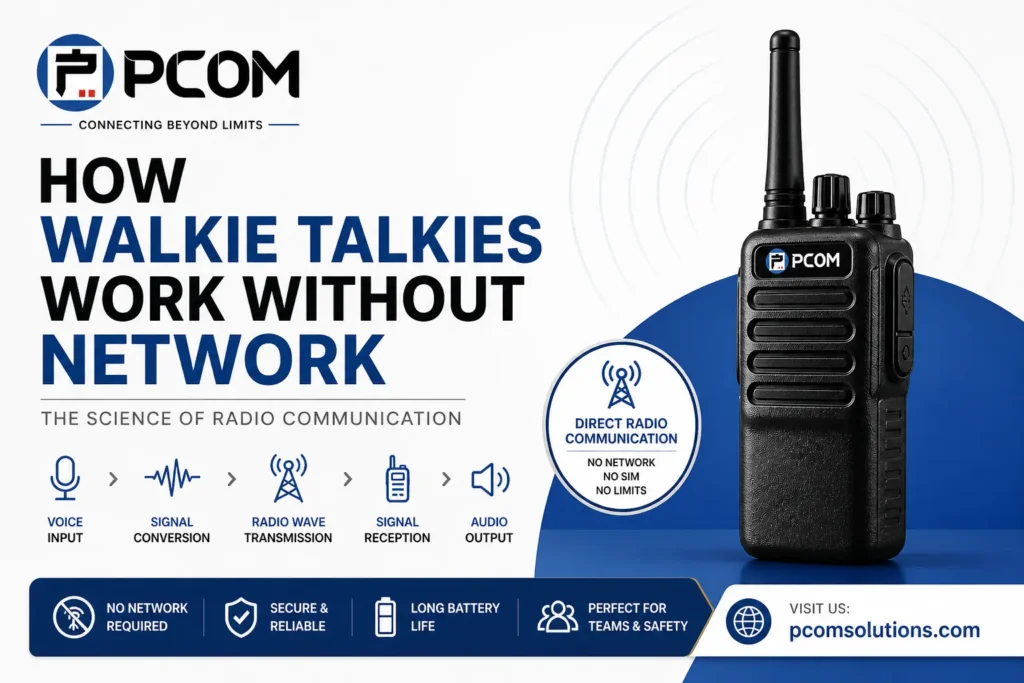
Push-to-talk (PTT) operation is straightforward from the user’s perspective, but several electronic processes take place inside the radio.
First, voice capture: The microphone converts speech into an electrical audio signal.
Second, signal processing: The radio prepares the voice for transmission. In an analog radio, the audio is processed for the supported modulation method. In a digital radio, the voice is encoded into digital information before transmission.
Third, RF transmission: The transmitter generates the radio-frequency signal and sends it through the antenna.
Fourth, signal reception: A compatible receiving radio detects and processes the incoming transmission.
Finally, audio playback: The receiving radio recovers the voice information and reproduces it through its speaker.
The receiving equipment must support compatible frequencies and communication parameters. Digital radios may also require compatible protocols and programming.
3. Analog and Digital Two-Way Radio Technology
Analog and digital radios serve many of the same communication needs, but they process voice differently.
Analog radios
Analog radios transmit voice using an analog modulation scheme. They can be suitable for conventional communication systems where simplicity and compatibility with existing equipment are important.
Digital radios
Digital radios convert voice into digital information and use a compatible digital transmission format. Depending on the technology, they may support group calling, individual calling, text messaging, telemetry and other communication functions.
Digital radio performance depends on the complete design and operating conditions. It should not be assumed that every digital radio provides greater range or clearer audio in every environment.
For industrial users and security operators, the decision should consider required features, existing infrastructure, interoperability, operating conditions and total system cost.
4. Which Walkie-Talkie Specifications Matter Most?
Technical specifications help buyers compare radios objectively. However, figures should always be interpreted according to their definitions and test conditions.
Transmit power
Transmit power describes the RF power delivered at a defined point in the transmitter system. Datasheets may specify conducted RF output power, which is not the same as the total radiated power from the antenna.
Higher transmit power does not guarantee proportionally greater communication range. Antenna performance, receiver characteristics, interference, terrain and obstructions also affect coverage.
Receiver sensitivity
Receiver sensitivity indicates the minimum input signal level at which a receiver meets a specified performance criterion.
For analog radios, the specification may be expressed using a defined SINAD criterion. For digital radios, sensitivity may be specified at a particular bit error rate (BER) or another defined performance threshold.
For a meaningful comparison, check the measurement conditions, frequency, modulation mode and performance criterion. A lower required input level in microvolts generally indicates better sensitivity when the measurement conditions are equivalent.
Frequency band
The operating frequency affects radio-system design and propagation characteristics. VHF and UHF equipment may be suited to different applications, but actual coverage depends on the complete system and the environment.
Frequency selection must also comply with the applicable spectrum allocation, licensing conditions and equipment requirements in the intended country.
Channel capacity and spacing
Channel capacity describes the number of channels that can be configured or stored, while channel spacing describes the separation between channel frequencies.
The practical requirements depend on the radio system, available spectrum and applicable technical regulations.
Battery capacity and operating time
Battery capacity helps buyers compare power sources, but actual operating time must be assessed using the radio’s operating profile and manufacturer-provided runtime data.
For procurement, confirm the battery type, rated capacity, charging requirements and availability of compatible replacement batteries.
Environmental protection
Industrial and security applications may require resistance to dust, water ingress, vibration or mechanical impact.
Check the specific model’s documented IP rating and any applicable test reports. An IP rating should not be interpreted as a general guarantee against every form of physical damage or every environmental condition.
5. How to Compare Two-Way Radios Using Datasheets
A useful technical comparison starts with equivalent specifications and consistent test conditions.
When evaluating two radio models, consider the following:
| Parameter | What to verify |
|---|---|
| Frequency range | Supported operating bands and exact frequency limits |
| RF output power | Rated output and applicable tolerances |
| Receiver sensitivity | Measurement method and test criterion |
| Modulation and protocol | Analog modes and supported digital standard |
| Audio output | Rated audio power and applicable distortion conditions |
| Battery | Chemistry, capacity, voltage and charging method |
| Channel capacity | Supported programmable channels and zones |
| Environmental rating | Documented IP rating and test conditions |
| Dimensions and weight | Radio weight, including or excluding battery as specified |
| Accessories | Compatibility with microphones, earpieces and chargers |
A specification comparison should distinguish between declared values, tested results and features that depend on configuration.
For example, receiver sensitivity values should not be compared directly if one is specified under an analog SINAD test and the other under a digital BER test. Similarly, battery runtime figures are only meaningfully comparable when the test conditions are sufficiently similar.
6. What Should Industrial and Security Users Consider?
The correct radio depends on the environment in which it will be used.
Security operations: Consider audio intelligibility, battery endurance, discreet accessories where appropriate, emergency functions and the ability to communicate across the required coverage area.
Manufacturing and industrial facilities: Assess environmental protection, resistance to everyday handling, audio performance in noisy areas and compatibility with the site’s communication system.
Construction and infrastructure: Consider coverage across the worksite, equipment durability, accessory requirements and whether repeaters or other infrastructure are needed.
Warehousing and logistics: Evaluate channel planning, ease of operation, battery endurance and compatibility with the communication requirements of different teams.
These requirements should be translated into measurable technical criteria before selecting equipment.
7. What to Look for in a Walkie-Talkie OEM Manufacturer
For distributors, system integrators and businesses sourcing radios under their own brand, the evaluation should extend beyond the headline product specifications.
A practical OEM assessment may include:
-
Product documentation: Complete technical datasheets, operating manuals and relevant test documentation.
-
Specification verification: Clearly defined performance parameters and test methods.
-
Configuration options: Available frequency bands, analog or digital variants, approved accessories and supported features.
-
Quality assurance: Documented inspection procedures, production controls and traceability appropriate to the product.
-
Regulatory compliance: Applicable approvals, spectrum requirements and documentation for the intended market.
-
Supply and support: Production capacity, lead times, spare parts, warranty terms and technical support arrangements.
-
Customization requirements: Confirmed options for branding, packaging, firmware configuration and other OEM services.
OEM capabilities differ between manufacturers and product families. Buyers should verify each requested capability directly rather than assuming that every model supports every customization option.
8. Building a Radio Specification Around the Application
A good radio specification begins with the communication requirement, not a preferred model number.
Start by defining the coverage area, expected user count, operating environment, required communication features and daily operating duration. Then identify the frequency authorization, compatibility and performance requirements.
Once these requirements are clear, compare relevant datasheets and request additional test information where necessary.
For larger facilities or challenging coverage areas, an assessment of the radio system may also be needed. A repeater, suitable antenna installation or improved radio placement can sometimes address coverage limitations more effectively than changing the handheld radio alone.
Conclusion
A professional walkie-talkie combines antenna technology, RF transmission and reception, audio processing, control electronics and power management in a compact communication device.
For industrial and security users, understanding these components helps clarify which specifications matter and how they relate to practical operation. For OEM buyers, a structured comparison of documented performance, product configuration, quality controls and regulatory requirements can support a more informed sourcing decision.
At [Company Name], our focus is on [insert verified manufacturing or OEM capabilities] for professional two-way radio applications. Contact our team to discuss your product requirements, technical specifications and intended operating environment.
Note: Replace the company statement above with verified details about your business before publishing.
 Call to Action
Looking for the right walkie talkie for your business?
 Visit: www.pcomsolutions.com Explore professional communication solutions
👉 Contact us today for a customized solution.