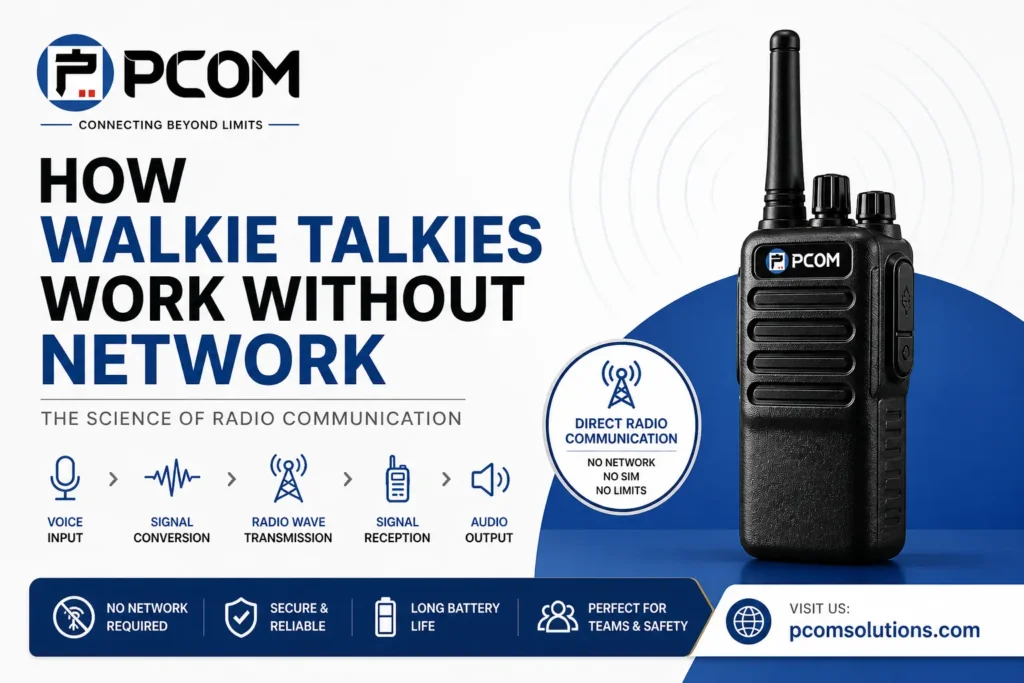
Walkie talkies are one of the most reliable communication devices, especially in areas where mobile networks fail. But have you ever wondered how walkie talkies work without any network or SIM card?
In this guide, we’ll break it down in a simple yet technical way—perfect for both beginners and professionals.
 Primary ARTICLES
-
- walkie talkie without network
-
- how walkie talkies work
-
- radio communication devices
-
- license free walkie talkie India
-
- two way radio communication system
-
- analog vs digital walkie talkie
 What Is a Walkie Talkie?
A walkie talkie (two-way radio) is a wireless communication device that allows users to talk directly using radio frequencies, without relying on cellular networks, Wi-Fi, or internet.
 How Walkie Talkies Work Without Network
Walkie talkies operate using radio waves, not telecom infrastructure.
 Simple Working Principle:
-
- Your voice is captured by a microphone
-
- It converts sound into radio signals
-
- Signals are transmitted via antenna
-
- Nearby devices receive the signal
-
- The signal is converted back into sound
 Communication Flow Table
| Step | Process | Description |
|---|---|---|
| 1 | Voice Input | User speaks into microphone |
| 2 | Signal Conversion | Audio → Radio signal |
| 3 | Transmission | Signal sent via antenna |
| 4 | Reception | Other radio receives signal |
| 5 | Output | Signal → Audio sound |
 Why No Network Is Required?
Unlike mobile phones, walkie talkies:
-
- Do not depend on telecom towers
-
- Use direct device-to-device communication
-
- Work on licensed or license-free radio frequencies
 This is called peer-to-peer communication
 Frequency Bands Used
Walkie talkies operate on specific frequency ranges:
| Type | Frequency | Use Case |
|---|---|---|
| UHF | 400–470 MHz | Indoor, buildings |
| VHF | 136–174 MHz | Outdoor, open areas |
| License-Free (India) | 446 MHz | Short-range personal use |
 Types of Walkie Talkies
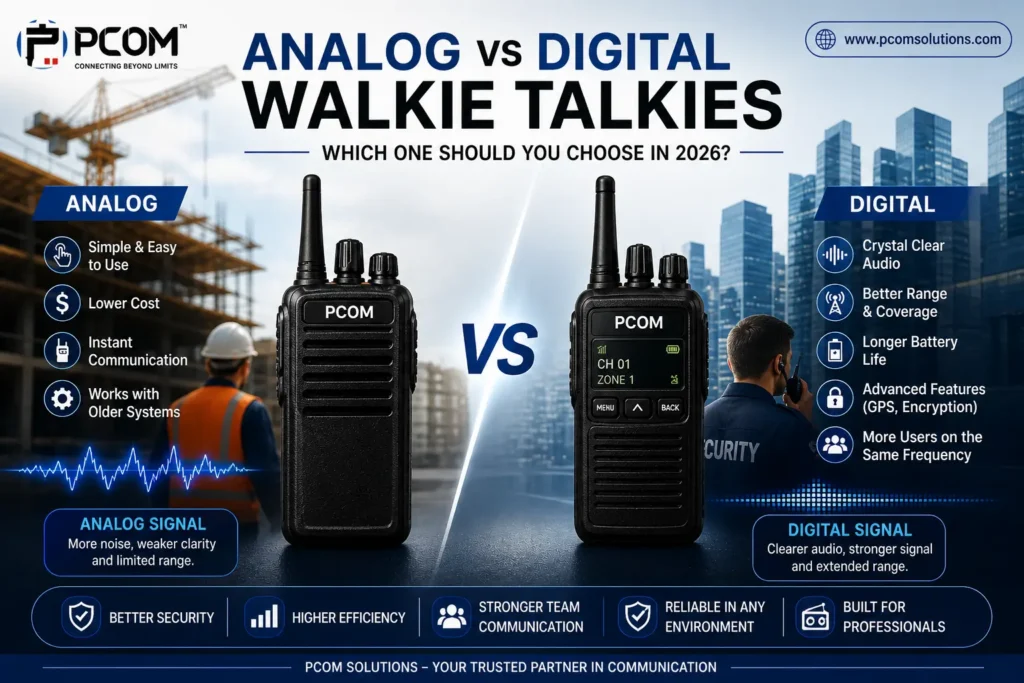
1. Analog Walkie Talkies
-
- Simple and cost-effective
-
- Slight background noise
-
- Ideal for basic communication
2. Digital Walkie Talkies
-
- Clear audio quality
-
- Encryption & advanced features
-
- Better battery efficiency
 Key Features of Modern Walkie Talkies
-
 Push-to-Talk (PTT) communication
-
 Long battery life
-
 Secure & encrypted communication
-
 No dependency on mobile networks
-
- Instant connection (zero latency)
 Where Are Walkie Talkies Used?
Walkie talkies are widely used in:
-
- Construction sites
-
- Security agencies
-
- Railways & logistics
-
- Hotels & event management
-
- Disaster rescue operations
 Advantages Over Mobile Phones
| Feature | Walkie Talkie | Mobile Phone |
|---|---|---|
| Network Required |  No No |
 Yes Yes |
| Communication Speed | Instant | Delayed |
| Reliability | High | Medium |
| Cost | One-time | Recurring bills |
| Group Communication | Easy | Limited |
 Real-World Example
During disasters like earthquakes or network outages, walkie talkies continue to function, making them critical for emergency communication systems.
 External Resources
-
- Learn about radio communication: https://en.wikipedia.org/wiki/Two-way_radio
-
- Frequency regulations in India: https://dot.gov.in
-
- Wireless Planning & Coordination (WPC): https://wpc.dot.gov.in
 Conclusion
Walkie talkies work without a network because they use direct radio frequency communication instead of relying on telecom infrastructure.
This makes them:
-
- Reliable
-
- Fast
-
- Essential for mission-critical communication
Looking for reliable walkie talkies?
Explore high-performance communication devices at: www.pcomsolutions.com
Call to Action
Looking for reliable and high-performance walkie talkies?
Explore our latest range of professional devices designed for security, industrial, and commercial use.
👉 Contact us today to find the perfect solution for your needs.
UHF vs VHF Walkie Talkies: Complete Comparison Guide (2026)
How Walkie Talkies Work Without Network (Complete Guide)
What is a Walkie Talkie? Complete Beginner Guide