LICENSE-FREE WALKIE TALKIES
1. Introduction & Definition
A license-free walkie talkie (or license-exempt two-way radio) is a portable radio transceiver that operates on frequencies and power levels designated by regulation as exempt from a user license. These devices are designed for short-range, peer-to-peer communication without the administrative overhead of individual radio licensing.
While “license-free” does not mean completely unregulated, it means that end users—subject to compliance with specified technical limits—can legally use them without applying for a radio license.
2. Global Standards & Key Radio Bands
2.1 PMR446 (Europe & many other markets)
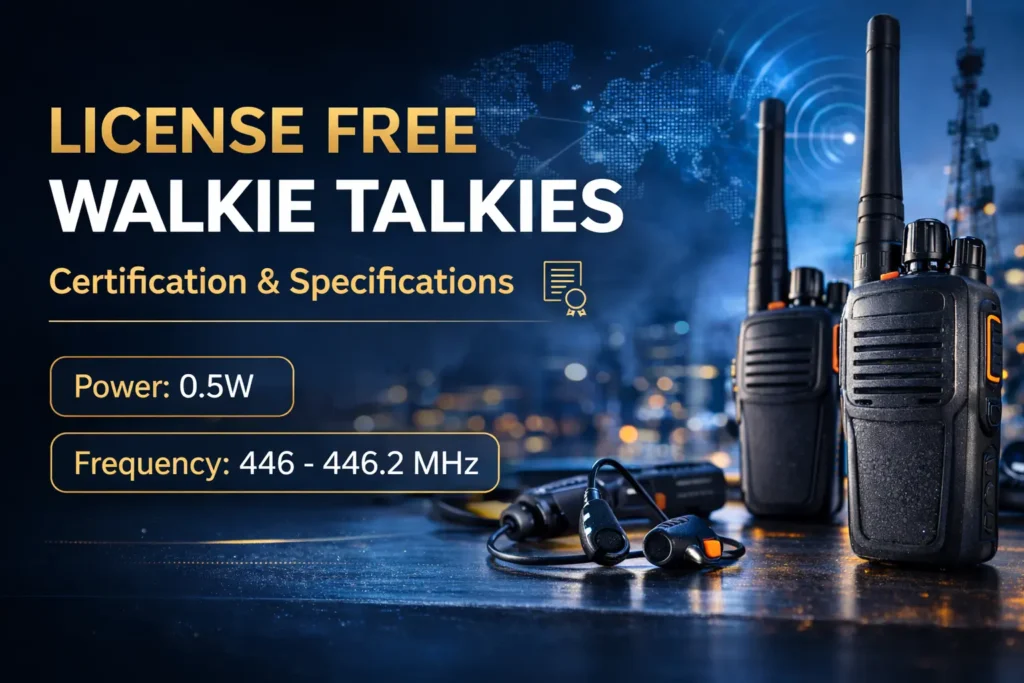
The PMR446 band (446.0 – 446.2 MHz) is one of the most common license-exempt bands globally (especially in Europe). (Wikipedia)
Devices operating in PMR446 are limited to 0.5 W effective radiated power (ERP) and must use an integral (non-removable) antenna to control interference and maintain simplicity. (Wikipedia)
Analogue PMR446 typically supports 16 FM channels spaced at 12.5 kHz. (Wikipedia)
Digital variants—such as dPMR446 and DMR Tier I—use narrower 6.25 kHz spacing, FDMA/TDMA modulation, and enable more efficient voice or data transmission. (Wikipedia)
Importantly, PMR446 is designated for non-infrastructure use (i.e., no repeaters, no base stations) to keep the system simple and open. (Wikipedia)
2.2 Region-Specific Variants (India, etc.)
In India, the Wireless Planning & Coordination (WPC) department under the Department of Telecommunications (DoT) allows 446.0–446.2 MHz for use by “Personal Mobile Radio 446 MHz devices” with power up to 500 mW ERP under the “Exemption from Licensing Requirement” rules (G.S.R. 1047(E)) published in 2018.
The exemption mandates that devices must be portable, use integral antennas, and not form part of infrastructure or repeaters.
Although users are exempt from licensing, manufacturers/importers must secure an Equipment Type Approval (ETA) certificate from WPC.
Use of non-approved devices, or modifications exceeding allowed limits, can lead to statutory penalties under India’s Wireless Telegraph Act.
3. Technical Specifications & Limitations
Here is a summary of the typical technical constraints for license-free walkie talkies (especially PMR446), plus how they affect performance:
| Parameter | Typical Standard / Regulatory Limit | Impact / Reason |
|---|---|---|
| Frequency band | 446.0 – 446.2 MHz (for PMR446) | Keeps interference manageable and harmonizes user equipment |
| Maximum transmit power (ERP) | 0.5 W (500 mW) | Controls range and avoids interference with licensed services |
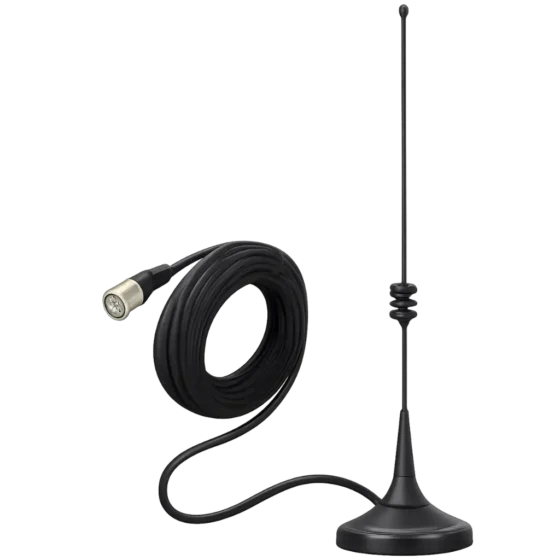
| Antenna type | Integral (non-removable) only | Prevents users from attaching high-gain antennas and exceeding range |
| Channel spacing (analogue) | 12.5 kHz | Standard spacing to reduce overlap and maintain channel separation |
| Channel spacing (digital) | 6.25 kHz (dPMR) | More channels in the same band, more efficient spectrum use |
| Modulation / Mode | FM (analogue); digital FDMA or TDMA (in newer models) | Digital modes offer better spectral efficiency and features |
| Usage mode | Mobile / handheld only (simplex) | No repeaters / no infrastructure allowed under license-free rules |
| Spurious / unwanted emissions | Must comply with strict limits (e.g. ≤ certain micro-watt levels) | Prevents interference with adjacent bands & licensed services |
Because of those limitations, range is a function of environment, antenna height, and obstructions. In open line-of-sight conditions, a typical PMR446 radio might reach 2–5 km; in dense urban settings, the range could shrink to a few hundred meters. (midlandeurope.com)
Digital variants (e.g., dPMR) can sometimes slightly extend effective use due to better error correction and narrower channel spacing, but their performance is still bounded by transmit power limits. (Wikipedia)
4. Regulatory Landscape & Compliance
4.1 Europe / EU & CE / RED Requirements
In the European Union, PMR446 is harmonized under the EU Radio Equipment Directive (RED). Devices must carry CE marking and meet essential requirements for safety, EMC (Electromagnetic Compatibility), and radio performance. (red-radio.co.uk)
Digital (non-harmonised) PMR devices must also comply with national rules in each country, which can impose additional restrictions.
4.2 India / WPC & ETA
As mentioned, under G.S.R. 1047(E), 2018, devices in 446.0–446.2 MHz up to 500 mW ERP are exempt from licensing (for users) but manufacturing/import must get ETA (Equipment Type Approval) from WPC.
The WPC ETA certification ensures that device adheres to frequency tolerance, spurious emission norms, and power constraints.
E-commerce platforms, customs, and regulatory authorities increasingly enforce that only walkie talkie models with valid ETA certification be sold.
4.3 Enforcement & Risks
Use of non-compliant or modified devices (exceeding permitted power, external antennas, spurious emissions) can lead to confiscation, fines, and legal penalties. (Tech Achieve Media)
Also, misuse of license-free bands (e.g., interfering with critical services or using non-authorized frequencies) is a concern for regulators and raises national security implications. (Tech Achieve Media)
5. Applications & Use Cases
Because license-free walkie talkies strike a balance between simplicity and utility, they are widely used in many scenarios:
Event Management & Security — coordinating staff across venues, quick communications
Hotels, Resorts & Hospitality — staff channels between floors, housekeeping, maintenance
Small to Medium Enterprises / Factories / Warehouses — task coordination in indoor or campus settings
Retail / Malls / Shopping Complexes — store to floor communications, security
Outdoor Use / Recreation — hiking, camping, off-road, group outings
Construction / Site Use (non-critical) — short-range team coordination
Tour Operators / Tourist Groups — guiding & group management
Because license-free radios are simple to use, don’t require licensing delays, and are relatively low cost, they are suited for non-mission-critical communication. However, for mission-critical or long-distance communication, licensed or proprietary solutions are often preferred.
6. Advantages & Limitations
Advantages
No licensing delay or paperwork for users — ready to use out of box
Lower device cost compared to licensed radios
Ease of deployment — portable, simple controls, minimal training
Regulated but user-friendly constraints keep interference manageable
Broad availability of models and features (analogue, digital, rugged, waterproof)
Limitations
Limited range due to 0.5 W power cap and use of integral antenna
No infrastructure / repeater support allowed
Possible interference in crowded environments (many users in same frequencies)
Proximity to obstructions significantly degrades performance (walls, metal, terrain)
Strict regulatory compliance needed — non-compliance can be penalized
Feature limitations compared to licensed systems (e.g. encryption, trunking, networked operation)
7. Best Practices & Design Guidelines
To get optimal performance and compliance, manufacturers and users should follow these guidelines:
Strict adherence to spectrum regulation — 446.0–446.2 MHz only, ≤0.5 W ERP, integral antenna.
Stay within spurious emission norms — design filters to limit emissions outside the band.
Frequency stability & tolerance — ensure frequency drift is minimal (often ±5 ppm or better).
Implement noise suppression / squelch / CTCSS / DCS — to reduce interference between users.
Rugged & ergonomic design — shockproof, water/dust resistance (IP ratings) for real-world use.
Battery & power management — long standby time, low current draw in idle mode, efficient transmit circuitry.
User interface / simplicity — clear display, intuitive controls, channel scanning, VOX, etc.
Regulatory labeling & documentation — include model, frequency range, power rating, CE/ETA marks, user manual.
User training / awareness — educate users not to tamper with hardware for increased power or antenna gain.
Periodic certification & compliance — ensure units in the field stay within spec and re-test if hardware changes.
8. Example Devices & Specifications
Talkpod F40 — 0.5 W PMR446, uses 16 PMR channels, IP54 water protection, 1,100 mAh battery, USB-C charging. (Talkpod)
Midland XT70 — fixed antenna, 8 PMR446 channels, 500 mW ERP, VOX, CTCSS, USB charging. (passion-radio.com)
These are examples; always check whether the sold unit is truly compliant (especially in your country) and has required certification.
9. The Indian Context: Challenges & Trends
The 2018 exemption of 446 MHz band under G.S.R. 1047(E) opened up the license-free radio market in India.
Regulatory scrutiny has increased: e-commerce platforms have been directed to delist non-approved radio models.
Security agencies have flagged misuse or illegal modifications of license-free walkie talkies as potential risks, especially when used for unauthorized communications. (Tech Achieve Media)
10. Summary & Outlook
License-free walkie talkies strike a practical balance for short-range, ad-hoc voice communication without regulatory hassle for users. Their design is governed by well-defined technical and regulatory frameworks—especially around frequency, power, antenna, and emissions.
While they are not suited for high-stakes or long-range communication, they shine in event coordination, facility management, recreational uses, and light industrial tasks. In markets like India, compliance (ETA certification) and vigilance against misuse are increasingly critical.
As digital radio technologies (e.g. DMR, dPMR) evolve and spectral efficiency improves, the capabilities of license-free radios are likely to grow, making them more resilient and feature-rich while staying within the regulatory envelope.
Featured Products

Categories